

Some common street names for cocaine include coke, blow, snow, powder, flake, white, and nose candy. Other terms appear in different regions, age groups, and social circles, so no single list includes every term.
Cocaine is a powerful and addictive stimulant. People may use slang words instead of the drug’s proper name in texts, conversations, music, movies, or social settings. This can make it difficult for parents, teachers, friends, and other concerned people to understand what they are hearing. Knowing common cocaine slang can help someone recognize a conversation that may involve drug use without assuming that every use of a slang word proves cocaine is present.
The meaning of a term can also change with location and context. Some words refer generally to cocaine, while others may describe a particular form or a combination involving another substance. That is why context matters. The goal of this guide is simple: to explain commonly reported cocaine street names, where the terms come from, and why recognizing them can be useful. ⚠️
What Are Cocaine Street Names?
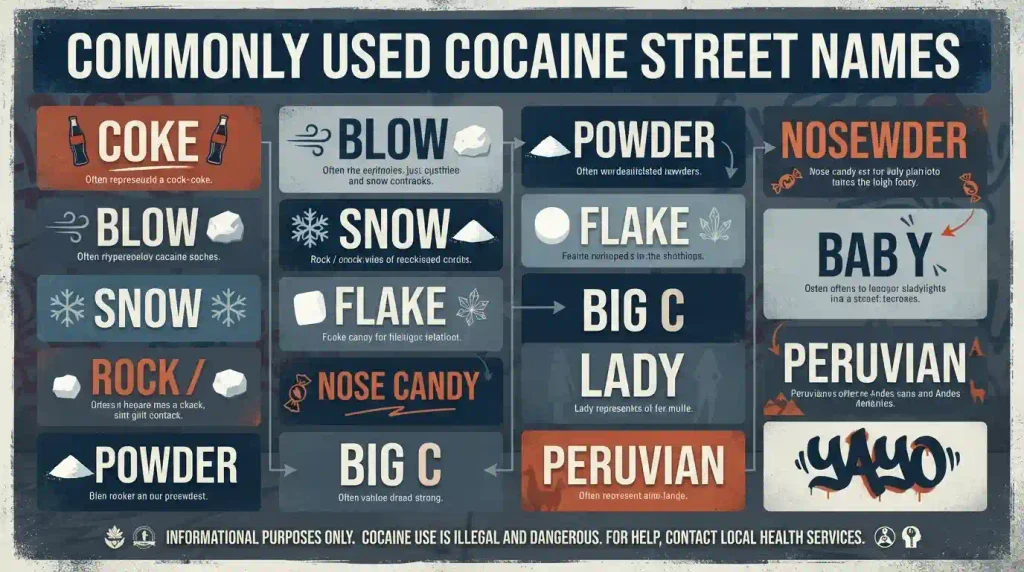
Cocaine street names are informal words or phrases used to refer to cocaine instead of using its actual name. These terms can come from the drug’s appearance, effects, history, or cultural use.
Current sources commonly report names such as coke, blow, snow, powder, flake, Big C, and nose candy. The exact vocabulary differs between communities and countries.
It is important not to treat slang as a perfect codebook. A word can have more than one meaning, and some terms can refer to different drugs or drug combinations.
Common Street Names for Cocaine ❄️
Coke
Meaning & Origin: “Coke” is one of the most widely recognized shortened forms of cocaine. It is commonly reported in drug education resources.
Best For: Recognizing casual references to cocaine in conversations, messages, or media.
Blow
Meaning & Origin: “Blow” is a long-standing slang term associated with cocaine. Its use is widely documented in drug slang references.
Best For: Understanding informal conversations where cocaine is not called by its formal name.
Snow
Meaning & Origin: “Snow” refers to the white appearance commonly associated with powdered cocaine.
Best For: Recognizing a common appearance-based slang term.
Powder
Meaning & Origin: “Powder” can be used to describe cocaine in its powdered form. However, the word by itself does not prove that cocaine is being discussed.
Best For: Understanding context when the surrounding conversation suggests drug use.
Flake
Meaning & Origin: “Flake” or “big flake” is reported as cocaine slang and is associated with the appearance of the substance.
Best For: Recognizing an appearance-related term in drug-related conversations.
Big C
Meaning & Origin: “Big C” is another reported nickname for cocaine.
Best For: Understanding shortened or indirect references to cocaine.
Nose Candy
Meaning & Origin: “Nose candy” is a well-known slang expression associated with cocaine.
Best For: Recognizing slang in informal speech, entertainment, or online discussions.
Snowflake
Meaning & Origin: “Snowflake” is reported among cocaine slang terms, although slang meanings can vary between communities.
Best For: Understanding older or less universal cocaine-related slang.
Cocaine Slang Based on Appearance ❄️
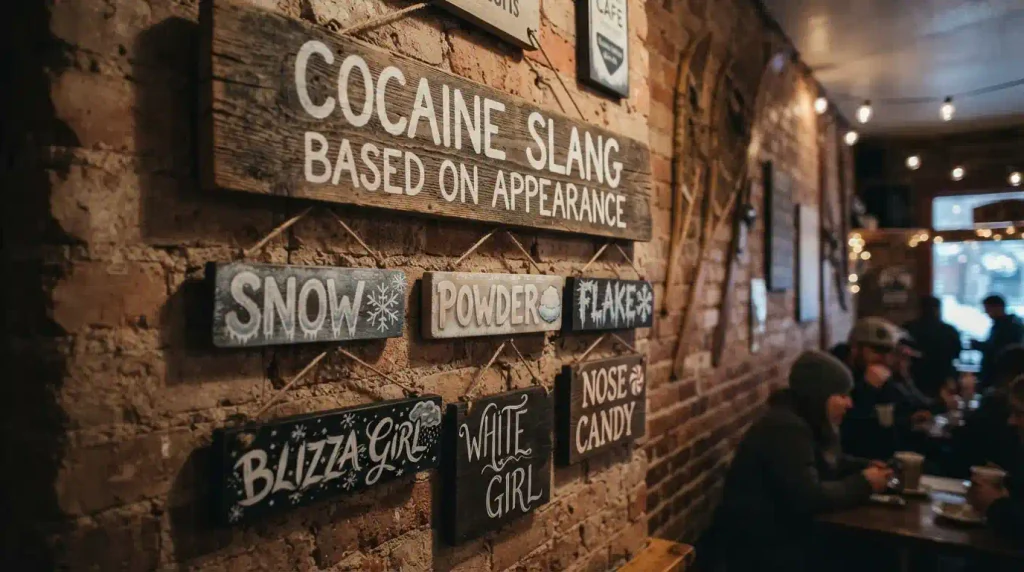
Some slang develops from the physical appearance of powdered cocaine. Words connected with white, snow, powder, flake, pearl, and icing have appeared in different slang lists.
However, appearance-based words can be especially unclear. For example, “powder” is a normal English word and can describe many harmless substances. A single word should never be treated as proof of drug use.
The surrounding conversation is much more important than the slang word itself.
Cocaine Slang Based on Its Effects
Some expressions have been linked with the stimulating or euphoric effects associated with cocaine. Examples reported by drug education sources include rush, happy dust, and marching dust.
These expressions are not reliable descriptions of what a substance actually contains. Street drugs can contain unexpected substances, and slang does not tell you the purity or contents of a drug.
That is one reason drug-related conversations should be taken seriously when several warning signs appear together.
Regional and Cultural Cocaine Slang 🌎
Cocaine slang is not the same everywhere. A word that is familiar in one country may be uncommon or have another meaning somewhere else.
For example, sources covering British and Irish usage report terms such as Charlie, beak, snow, and ching, while U.S.-focused sources more commonly report terms such as coke, blow, snow, and nose candy.
This regional difference is important for parents, writers, researchers, and anyone trying to understand a conversation. A slang dictionary can provide clues, but context is still necessary.
Older Cocaine Street Names
Some cocaine slang has been around for decades. Historical lists include terms such as Big C, Blanca, white powder, gold dust, lady, and love affair.
Older terms may appear in movies, songs, books, older news reports, or conversations involving people from different generations.
Not every historical term remains common today. Slang changes quickly, and some expressions disappear while new ones appear.
Cocaine Terms That Can Mean Something Else
This is one of the most important things to remember.
A slang word does not automatically mean cocaine. Terms such as powder, snow, white, rock, candy, and flake can have ordinary meanings outside drug discussions.
Even terms listed as cocaine slang may refer to something different in another setting. Some reported slang can also describe combinations of cocaine with other substances.
For that reason, avoid accusing someone based on one word alone. Look at the complete context.
Cocaine Slang and Drug Combinations ⚠️
Some slang terms are used for combinations involving cocaine and other substances. Examples reported in drug education sources include terms for combinations involving heroin, PCP, marijuana, or other drugs.
These combination terms are especially important from a safety perspective because a nickname does not tell you exactly what is present.
A person may also use a term without knowing its precise meaning. That makes slang unreliable for identifying the contents of an unknown substance.
Why Do People Use Cocaine Street Names?
There are several reasons slang develops around illegal drugs.
To Avoid Saying the Drug’s Name
People may use informal words instead of the drug’s proper name during conversations or messages.
To Fit Into a Social Group
Groups sometimes develop their own vocabulary. Words can spread through friends, music, entertainment, and online communities.
Because Slang Changes Over Time
Drug slang is not fixed. New expressions can appear while older ones become less common. Current sources specifically note that cocaine terminology varies by region and social group.
To Make Serious Topics Sound Casual
A nickname can make an illegal or dangerous substance sound less serious. The nickname does not change the health risks associated with cocaine.
Cocaine Street Names Parents May Hear 👨👩👧
Parents may encounter cocaine slang in texts, social media posts, gaming chats, music, or conversations between young people.
Some commonly reported terms include:
- Coke
- Blow
- Snow
- Powder
- Flake
- Big C
- Nose candy
- White
- Coca
- Yayo
- Charlie
- Lady
These terms have different levels of recognition and may vary by region.
The important point is not to memorize every possible word. Instead, recognize that coded language can sometimes appear alongside other signs of substance use.
Signs That a Conversation May Be Drug Related
A slang word alone is not enough to establish drug use. However, context can make the meaning clearer.
Possible clues include:
- Several drug-related terms appearing together
- Conversations about buying or selling substances
- Sudden secrecy around messages
- References to getting high or coming down
- Repeated references to powder or cocaine-related slang
- Drug-related paraphernalia
- Sudden changes in behavior or social groups
These signs can have other explanations too. A calm conversation is usually more helpful than making an immediate accusation.
What Should You Do If You Find Cocaine Slang?
If you are a parent, teacher, friend, or family member and you see a possible drug reference, start by considering the context.
Ask what the person means rather than immediately assuming the worst. If several signs suggest drug use, consider speaking with a qualified healthcare professional or substance-use specialist.
If someone may have taken cocaine and is experiencing severe symptoms such as chest pain, seizures, severe confusion, trouble breathing, or loss of consciousness, seek emergency medical help immediately.
Cocaine Street Names in Movies, Music, and Writing 🎬
Cocaine slang frequently appears in fictional stories, songs, movies, television, and older books. Writers may use terms such as “coke,” “blow,” or “snow” because they reflect informal speech.
When reading or writing fictional dialogue, remember that slang is strongly affected by time and location. A term that sounds natural in one decade may sound outdated in another.
For writers, context is more important than simply inserting many slang terms.
Are Cocaine Street Names the Same Everywhere?
No. Cocaine slang changes by country, region, generation, and social group.
For example, UK and Irish sources report “Charlie” as a familiar term, while U.S. sources commonly highlight “coke,” “blow,” and “snow.”
Some terms may also refer to a particular form of cocaine or a combination with another substance.
This is why there is no single complete worldwide list of cocaine street names.
Frequently Asked Questions
What is the most common street name for cocaine?
“Coke” is one of the most widely recognized street names for cocaine. Other common terms reported by drug education sources include “blow,” “snow,” “powder,” “flake,” and “nose candy.” Usage can vary by country, region, and social group.
What does “blow” mean in drug slang?
“Blow” is a common slang term for cocaine. It has been used for many years and appears in multiple drug slang references. However, slang can change by location, so the surrounding conversation should always be considered.
What does “snow” mean in drug slang?
“Snow” can refer to cocaine because of its commonly described white, powdery appearance. It is a widely reported cocaine slang term, although the word itself can obviously have many ordinary meanings.
What does “nose candy” mean?
“Nose candy” is an informal slang term for cocaine. It is commonly listed among cocaine street names and is generally associated with the drug’s recreational use.
Is “Charlie” a name for cocaine?
Yes. “Charlie” is reported as cocaine slang, particularly in British and Irish contexts. Slang differs between regions, so the word should be interpreted using the surrounding conversation rather than by itself.
Are cocaine street names the same as crack cocaine names?
Not always. Cocaine and crack cocaine are related, but they are different forms of the drug. Some slang terms specifically refer to crack, while others refer more generally to cocaine. Drug slang sources commonly separate terms for powdered cocaine from terms associated with crack or rock.
Can one slang word prove that someone is using cocaine?
No. A single word is not reliable proof of drug use. Many slang terms also have normal meanings, and people may use drug-related words when discussing music, movies, news, or fictional stories. Look at the broader context before drawing conclusions.
Why does cocaine slang keep changing?
Slang changes because language changes. Different regions, age groups, social circles, and online communities can create or adopt different terms. Some old names remain familiar while others disappear.
Conclusion
Knowing the street names for cocaine can help parents, families, educators, writers, and readers understand conversations that may otherwise be confusing. Common terms include coke, blow, snow, powder, flake, and nose candy, but the exact language changes by region and context.
The safest approach is to treat slang as a clue, not proof. If several signs point toward possible drug use, a supportive conversation and professional help can be much more useful than relying on slang alone.