
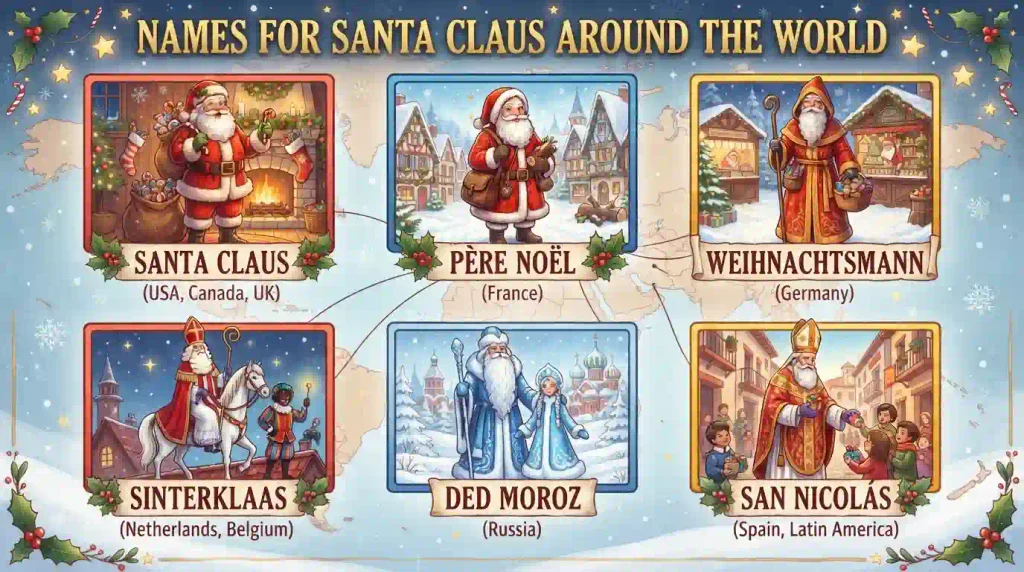
Santa Claus has many names around the world, including Father Christmas, Père Noël, Babbo Natale, Joulupukki, Papá Noel, and Ded Moroz. While some names directly translate to Santa Claus, others belong to older or separate gift-giving figures.
Christmas traditions change from country to country, and so do the names for Santa. In the United States, people usually say Santa Claus. In the United Kingdom, Father Christmas remains a familiar name, while France uses Père Noël, meaning Father Christmas. Germany uses Weihnachtsmann, or Christmas Man.
However, the story becomes even more interesting as you travel farther. Finland has Joulupukki, Italy has Babbo Natale, and Russia has Ded Moroz, known as Grandfather Frost. Some cultures also have other important gift-bringers, such as the Three Wise Men in Spain and La Befana in Italy.
So, if you’re looking for Santa names from different countries, this guide brings together popular names, simple meanings, cultural notes, and pronunciation help. 🎄
🎄 Popular Names for Santa Around the World
Here are some of the best-known names used for Santa or similar Christmas gift-bringers:
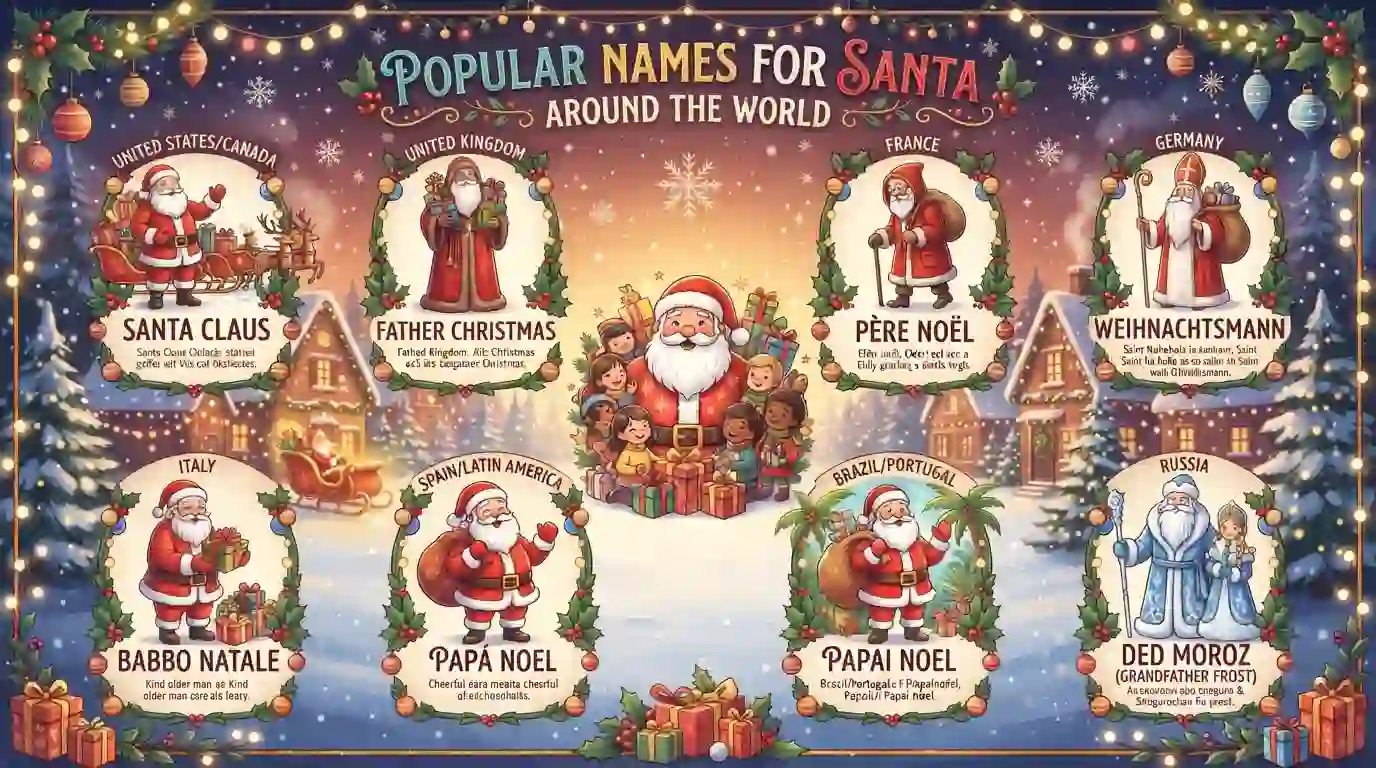
Santa Claus
Meaning & Origin: Santa Claus is the familiar English name used especially in the United States and Canada. The name developed from traditions connected with Saint Nicholas.
Best For: A classic Christmas character, story, username, character name, or holiday project.
Father Christmas
Meaning & Origin: Father Christmas is the traditional English name for Santa in the United Kingdom.
Best For: Classic British Christmas stories, cards, poems, and festive characters.
Père Noël
Meaning & Origin: Père Noël (pehr noh-EL) is French for “Father Christmas.” France uses this name for its Christmas gift-bringer.
Best For: French-themed Christmas names and European holiday characters.
Babbo Natale
Meaning & Origin: Babbo Natale (BAHB-boh nah-TAH-leh) means “Father Christmas” in Italian.
Best For: Italian Christmas themes, stories, and festive naming ideas.
🌍 Santa Names From Europe
Europe has some of the most interesting Santa names because Christmas traditions developed differently across the region.
Weihnachtsmann
Meaning & Origin: Weihnachtsmann (VY-nahkts-mahn) means “Christmas Man” in German. Germany also has traditions involving Saint Nikolaus and the Christkind.
Best For: German Christmas characters and traditional holiday stories.
Joulupukki
Meaning & Origin: Joulupukki (YOUL-oo-pook-kee) is the Finnish Christmas figure. The name is commonly translated as “Yule Goat.”
Best For: Unique Santa names, winter characters, and Nordic-inspired stories.
Julenissen
Meaning & Origin: Julenissen (YOO-leh-niss-en) is the traditional Christmas gift-bringer in Norway. The name is connected with the Scandinavian nisse tradition.
Best For: Nordic Christmas stories and fantasy characters.
Jultomte
Meaning & Origin: Jultomte (YOOL-tom-teh) is used in Swedish Christmas traditions and is often translated as Christmas gnome or Christmas brownie.
Best For: Cute Christmas characters with a small, magical feel.
Julemanden
Meaning & Origin: Julemanden (YOO-leh-man-den) is the Danish name for Santa Claus and means roughly “Christmas Man.”
Best For: Danish-inspired Christmas names and winter stories.
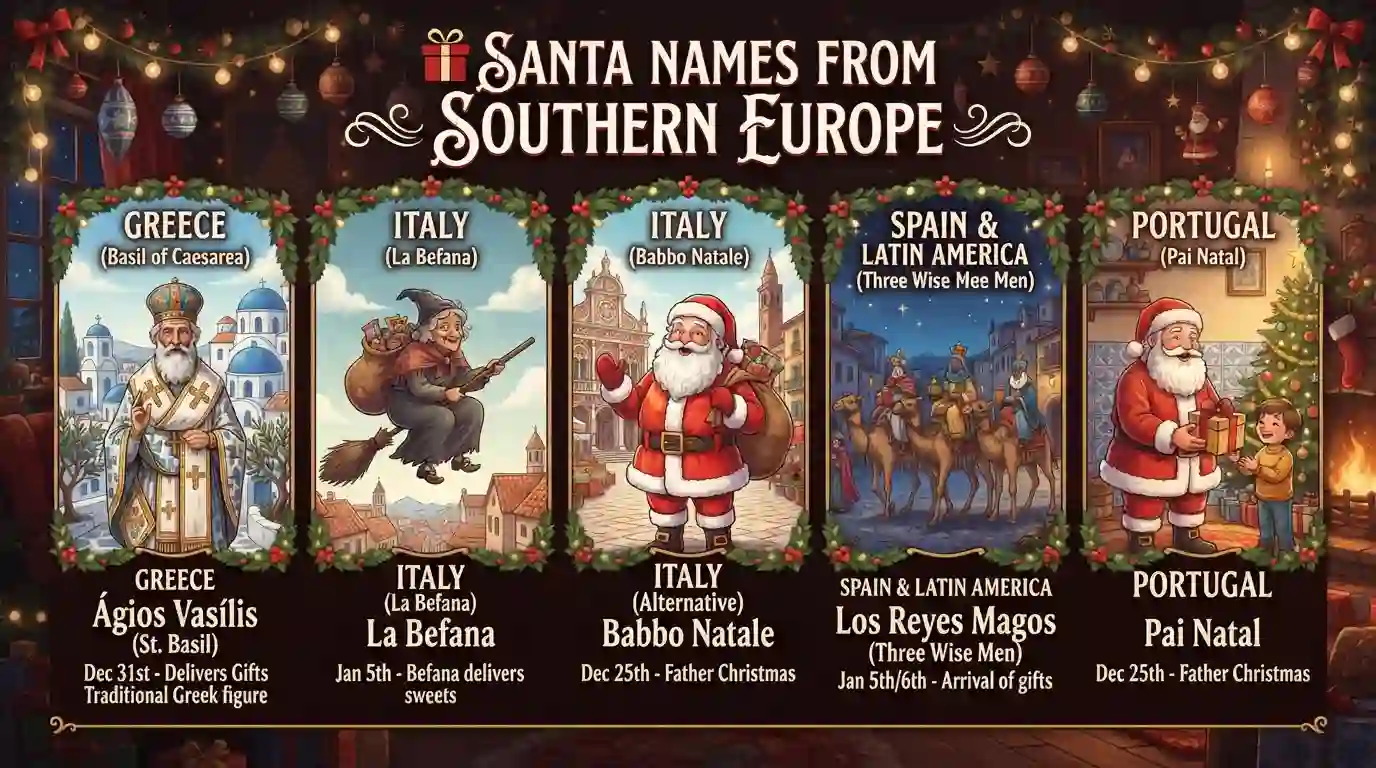
🎁 Santa Names From Southern Europe
Southern European countries often have Santa traditions alongside other important holiday figures.
Papá Noel
Meaning & Origin: Papá Noel (pah-PAH noh-EL) means “Father Christmas” in Spanish. Spain and many Latin American countries use the name, although traditions differ by country.
Best For: Spanish Christmas themes, festive characters, and holiday content.
Pai Natal
Meaning & Origin: Pai Natal (pie nah-TAHL) means “Father Christmas” in Portuguese and is used in Portugal.
Best For: Portuguese-inspired Christmas stories and character names.
Agios Vasilis
Meaning & Origin: Agios Vasilis (AH-gee-os vah-see-LEES) is the Greek name connected with Saint Basil, an important gift-bringing figure in Greek Christmas and New Year traditions.
Best For: Greek-inspired holiday characters and traditional Christmas writing.
Noel Baba
Meaning & Origin: Noel Baba (NOH-el BAH-bah) means “Father Christmas” in Turkish. The name is often associated with the New Year gift-bringer.
Best For: Turkish-inspired festive characters and international Christmas stories.
❄️ Santa Names From Northern Europe
Northern Europe offers some especially unusual names for Santa and winter gift-bringers.
Joulupukki
Meaning & Origin: Joulupukki is Finland’s well-known Christmas figure. Its traditional name connects Santa with the older Yule Goat tradition.
Best For: A rare and memorable Christmas character name.
Jólasveinn
Meaning & Origin: Jólasveinn (YOH-lah-svayn) refers to an Icelandic Yule Lad. Icelandic Christmas folklore includes a group of Yule Lads rather than one single Santa figure.
Best For: Fantasy stories, folklore projects, and unusual winter characters.
Jultomten
Meaning & Origin: Jultomten is the Swedish Christmas figure associated with gift-giving and older Scandinavian folklore.
Best For: Cute Nordic-inspired Santa names.
🎅 Santa Names From Eastern Europe
Eastern Europe has several winter gift-bringer traditions that do not exactly match the modern Western Santa.
Ded Moroz
Meaning & Origin: Ded Moroz (DYED moh-ROHZ) means “Grandfather Frost.” In Russian tradition, he is a winter gift-bringer and is commonly associated with New Year celebrations rather than the Western Christmas Santa.
Best For: Powerful winter characters, fantasy stories, and folklore-inspired names.
Święty Mikołaj
Meaning & Origin: Święty Mikołaj (SHVYEN-tih mee-KOH-wai) means “Saint Nicholas” in Polish. The figure connects with the long European tradition of Saint Nicholas.
Best For: Traditional Polish Christmas themes.
Mikuláš
Meaning & Origin: Mikuláš (MIK-oo-lash) is a Czech and Slovak form of Nicholas and is connected with Saint Nicholas traditions.
Best For: Central European holiday stories and cultural projects.
🌎 Santa Names in North and South America
The Americas use many variations of Santa, especially across Spanish- and Portuguese-speaking countries.
Papai Noel
Meaning & Origin: Papai Noel (pah-PIE noh-EL) means “Father Christmas” in Portuguese. It is the common Santa name in Brazil.
Best For: Brazilian Christmas themes and warm-weather holiday stories.
Viejo Pascuero
Meaning & Origin: Viejo Pascuero (VYEH-hoh pahs-KWEH-roh) means roughly “Old Man Christmas.” Chile uses this distinctive name for Santa Claus.
Best For: Chilean-inspired Christmas content and unique character names.
Colacho
Meaning & Origin: Colacho is a nickname related to Nicolás and appears as a Santa name in Costa Rican Christmas traditions.
Best For: A short, unusual name for a festive character.
San Nicolás
Meaning & Origin: San Nicolás means “Saint Nicholas” in Spanish. The name appears in several Latin American Christmas traditions.
Best For: Traditional Christmas stories and Saint Nicholas themes.
🗺️ Santa Names in Asia
Santa traditions also appear in several Asian countries, although local customs and Christmas celebrations vary.
Shèngdàn Lǎorén
Meaning & Origin: Shèngdàn Lǎorén (SHUNG-dahn laow-ren) is the Mandarin Chinese name commonly translated as “Christmas Old Man.”
Best For: Chinese-language Christmas projects and international stories.
Santa Kurōsu
Meaning & Origin: Santa Kurōsu (SAHN-tah koo-ROH-soo) is the Japanese rendering of “Santa Claus.” Japanese sources also use forms such as Santa-san.
Best For: Japanese-inspired Christmas characters and modern holiday content.
Santa Harabeoji
Meaning & Origin: Santa Harabeoji (SAHN-tah hah-rah-buh-jee) means “Santa Grandfather” in Korean usage.
Best For: Korean-themed festive stories and character names.
Ông Già Noel
Meaning & Origin: Ông Già Noel (ONG zah NOH-el) is a Vietnamese name for Santa Claus and can be translated as “Christmas Old Man.”
Best For: Vietnamese Christmas themes and international naming lists.
🎀 Cute Names for Santa
Some Santa names sound especially cheerful or playful. These can work well for children’s stories, classroom activities, games, and holiday characters.
Santa
Meaning & Origin: A short, friendly form of Santa Claus.
Best For: Cute characters, pets in Christmas stories, and simple usernames.
Saint Nick
Meaning & Origin: Saint Nick is a familiar nickname for Saint Nicholas.
Best For: Short Christmas captions and traditional holiday characters.
Father Christmas
Meaning & Origin: This classic title gives Santa a warm and caring family image.
Best For: Storybooks, Christmas cards, and traditional themes.
Christmas Man
Meaning & Origin: This is the simple English meaning of the German Weihnachtsmann.
Best For: Fun educational projects about Santa names in different languages.
✨ Unique Names for Santa
If you want something less familiar, these international Santa names stand out.
Joulupukki
Meaning & Origin: This Finnish name has a memorable connection to the Yule Goat tradition.
Best For: A unique Nordic Christmas character.
Ded Moroz
Meaning & Origin: The name means Grandfather Frost and comes from Eastern European winter traditions.
Best For: A strong winter character or fantasy story.
Viejo Pascuero
Meaning & Origin: This Chilean name has a warm “Old Man Christmas” meaning.
Best For: International Christmas projects.
Jólasveinn
Meaning & Origin: This Icelandic term belongs to the country’s Yule Lad tradition.
Best For: Folklore, fantasy, and winter-themed characters.
🌟 Traditional Names Connected With Saint Nicholas
Many Santa traditions connect directly or indirectly with Saint Nicholas, a fourth-century Christian bishop remembered for generosity. Over time, stories about Saint Nicholas mixed with local winter traditions and helped shape different gift-bringing figures.
Saint Nicholas
Meaning & Origin: Saint Nicholas is the historical figure behind many European gift-giving traditions.
Best For: Traditional Christmas stories and educational content.
Sinterklaas
Meaning & Origin: Sinterklaas is the Dutch form of Saint Nicholas and has its own celebration and traditions in the Netherlands.
Best For: Dutch holiday stories and cultural projects.
San Nioclás
Meaning & Origin: San Nioclás is an Irish form connected with Saint Nicholas.
Best For: Irish-inspired Christmas content.
🎄 Santa Names That Are Not Exactly Santa
One important point can make your list more accurate: not every Christmas gift-bringer is simply another name for Santa Claus.
For example, Spain has Los Reyes Magos, or the Three Wise Men, as major gift-bringers around Epiphany. Italy also has La Befana, a traditional gift-giving figure who visits around Epiphany. Germany has traditions involving the Christkind, while Russia’s Ded Moroz follows a different winter tradition.
So, when creating a worldwide Santa list, it’s better to call these figures “Santa-like” or “Christmas gift-bringers” when they have a separate cultural identity.
🌍 What Do Different Santa Names Have in Common?
Although the names sound very different, many share a few themes.
First, several names translate to Father Christmas, such as Père Noël, Papá Noel, Pai Natal, and Papai Noel. Others connect Santa with Christmas itself, including Weihnachtsmann and Shèngdàn Lǎorén.
Meanwhile, names such as Sinterklaas and Święty Mikołaj connect more directly with Saint Nicholas. Nordic names can also preserve older winter and Yule traditions.
That variety makes names for Santa around the world fun to explore. More importantly, the differences show how cultures adapt familiar holiday ideas in their own way.
❓ FAQ About Names for Santa Around the World
What is Santa called in different countries?
Santa has many names around the world. Common examples include Father Christmas in the UK, Père Noël in France, Weihnachtsmann in Germany, Babbo Natale in Italy, Joulupukki in Finland, Papá Noel in Spain, and Ded Moroz in Russia. However, some of these figures have traditions that differ from the modern American Santa Claus.
What is Santa called in France?
In France, Santa Claus is called Père Noël, which means “Father Christmas.” He is the traditional Christmas gift-bringer for many French families.
What is Santa called in Germany?
Germany commonly uses Weihnachtsmann, meaning “Christmas Man.” However, German Christmas traditions can also include Saint Nikolaus and the Christkind, depending on the region and tradition.
What is Santa called in Finland?
Santa is commonly known as Joulupukki in Finland. The name literally connects to the Yule Goat tradition, making it quite different from the usual English name Santa Claus.
What is Santa called in Russia?
The well-known winter gift-bringer is Ded Moroz, meaning “Grandfather Frost.” He traditionally belongs to New Year celebrations rather than simply copying the Western Santa tradition.
What is Santa called in Italy?
In Italy, Santa Claus is commonly called Babbo Natale, meaning “Father Christmas.” Italy also has the traditional gift-giving figure La Befana, who is associated with Epiphany.
What is Santa called in Japan?
In Japanese, Santa Claus is commonly written and pronounced as Santa Kurōsu. The form Santa-san is also used.
Are all Santa names actually the same character?
No. Some names are direct translations or local versions of Santa Claus, while others refer to separate cultural figures. For instance, Ded Moroz, La Befana, and the Three Wise Men have their own traditions and histories.
🎅 Conclusion
Names for Santa around the world show how one familiar Christmas idea can take many forms. From Santa Claus and Father Christmas to Joulupukki, Père Noël, Babbo Natale, and Ded Moroz, each name carries a different language, tradition, or cultural story.
When choosing a Santa name for a story, classroom activity, character, or holiday project, consider its meaning, sound, and cultural background. Most importantly, enjoy discovering how different communities celebrate the festive season. 🎁